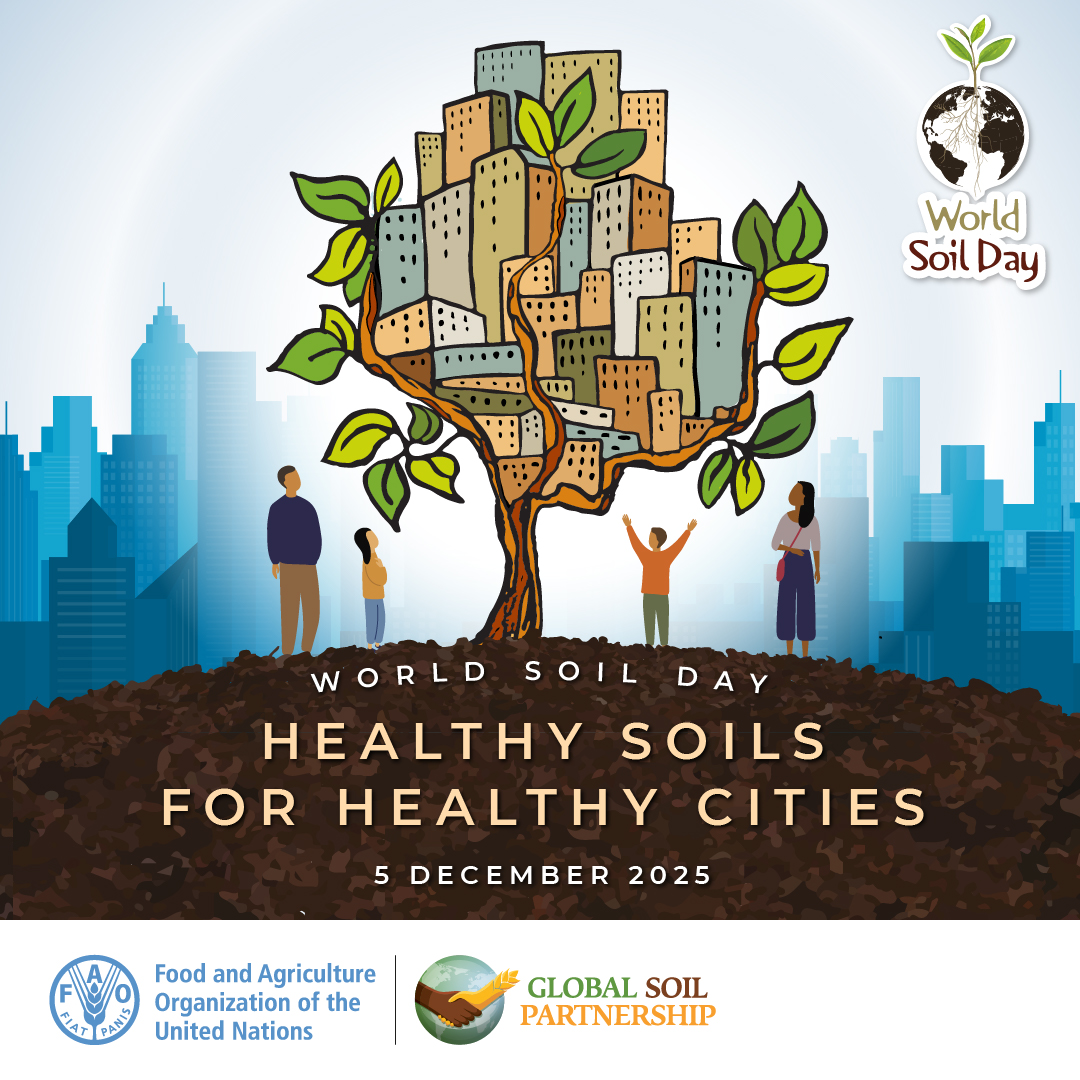
Today (5 December) is World Soil Day.
As planning begins for Christmas dinners and other food-related festivities, World Soil Day is a timely reminder of the importance of healthy soils not only for resilient and sustainable farms but also for our country’s culinary needs and food security.
95% of our food comes from soils. And yet, despite our utter reliance on soils, one-third of soils are degraded. Here in the UK, according to Defra, approximately four million hectares of soil is at risk of compaction and 2 million hectares at risk of erosion. Other studies have highlighted how 3 million tonnes of topsoil is lost annually.
Soil degradation harms yields and the longer-term business viability of farming. This can cause irreparable damage for future generations of farmers to make a living from the land. Poor levels of organic matter in soil reduce its ability to retain moisture therefore increasing vulnerability to droughts and flooding. What results is damage to crops and increased irrigation requirements.
Lost soil is also not coming back. It can take as many as 1,000 years to produce only two to three centimetres of soil.
There are environmental issues associated with soil degradation and soil loss. When sediment enters watercourses, it increases turbidity (the amount of particulate matter carried by the water). In turn, this reduces the amount of sunlight available for aquatic plants decreasing oxygen levels. Higher levels of sediment, moreover, can clog fish gills causing damage to the river ecosystem.
The Government has, for several years now, considered healthy soils as an essential public good and as an objective to be integrated into England’s system of agri-environmental payments. That is why under the 2024 Sustainable Farming Incentive (SFI), we saw the inclusion of several payment options to protect soil heath, such as no-till farming, winter cover crops and herbal leys. The SFI, of course, was suspended back in March but we are expecting the next iteration of the scheme to reopen next year along with the CS Capital Grant Scheme – although details remain scant for now.
On farms, rectifying water management issues are an essential way to protect and retain soils. Soil erosion is not always easily apparent, however. Gullies are not the only sign of soil erosion. Evidence of its occurrence can be seen as sandy deposits at the bottom of tramlines or “fans” of sand at the base of slopes. Soil erosion is also likely if you are having to maintain your ditches more regularly.
Even if soil is not leaving a field itself, it can be causing a loss of topsoil depth, through sheet wash, and loss of fertility from upper parts of a field.
There are a range of actions you could consider to rectify these issues from silt traps and bunds to cover crops and companion crops. Ensuring adequate water management – such as drains, gutters and keeping clean and dirty water separate – on your farmyard will also stop water gushing onto fields and creating gullies.
Other measures could be related to farm machinery, such as adopting controlled traffic systems and/or assisted steering, choosing the right tyre pressure and reducing tractor weights. Larger fields could be divided into smaller parcels with new hedgerows. Avoiding bare soils is also essential.
Drilling across the slope can help in some situations where the gradient safely allows. Yet, some field shapes and contours may make this impractical. In these situations, there are some instances where farmers have put in oblique tramlines where rows are drilled at a small angle to the tramline depending on field shape. This establishes small channels to intercept surface run-off down tramlines and increases the chances that the water will be taken up by the crops themselves.
These kinds of remedial actions can help your farm protect both its soils and its yields from water management issues. There can also be lower risks of accidents and insurance claims whilst boosting your farms resilience against the changing weather patterns we are expecting over the next several years and decades.
Catchment Sensitive Farming can support your farm – completely free-of-charge and on a confidential basis – to protect your soils, including if water management issues are a problem for your farm.
Please contact Jack or Estee at Catchment Sensitive Farming IW to access this support on 01983 296244.
This article was written by jack.philipsborn@naturalenterprise.co.uk
NB Articles are written independently of the Wight Rural Hub
Further resources:
- Learning from the Land Video Series (IfA, CSF & Ernest Cook Trust)
- Good Soil Guide – sustainable soil management, written by farmers
- AHDB Think Soils Manual – assess soil health & prevent erosion
- AHDB How to assess soil structure
- LandIS Glossary of Soil Terms
- LandIS Site Reporter
- LandIS Soilscapes Viewer